
Image
From The Plant Press, Vol. 27, No. 4, October 2024.
Over the past few months, Smithsonian botanists have discovered, described, and published 11 new plant species, a new plant genus, and established two new plant tribes. These taxa are found in South America, Africa, Asia, and the Pacific, and they represent unusual and unique additions to our understanding of the world’s flora. Some are threatened with extinction.

In Carvalho-Sobrinho et al. (2024), Laurence Dorr and colleagues describe a new Brazilian tree species, Eriotheca paganuccii (Bombacoideae, Malvaceae). This endangered species is endemic to montane wet forests near granitic-gneissic rock outcrops on summits of mountains in only three different locations in the Atlantic Forest of Bahia.
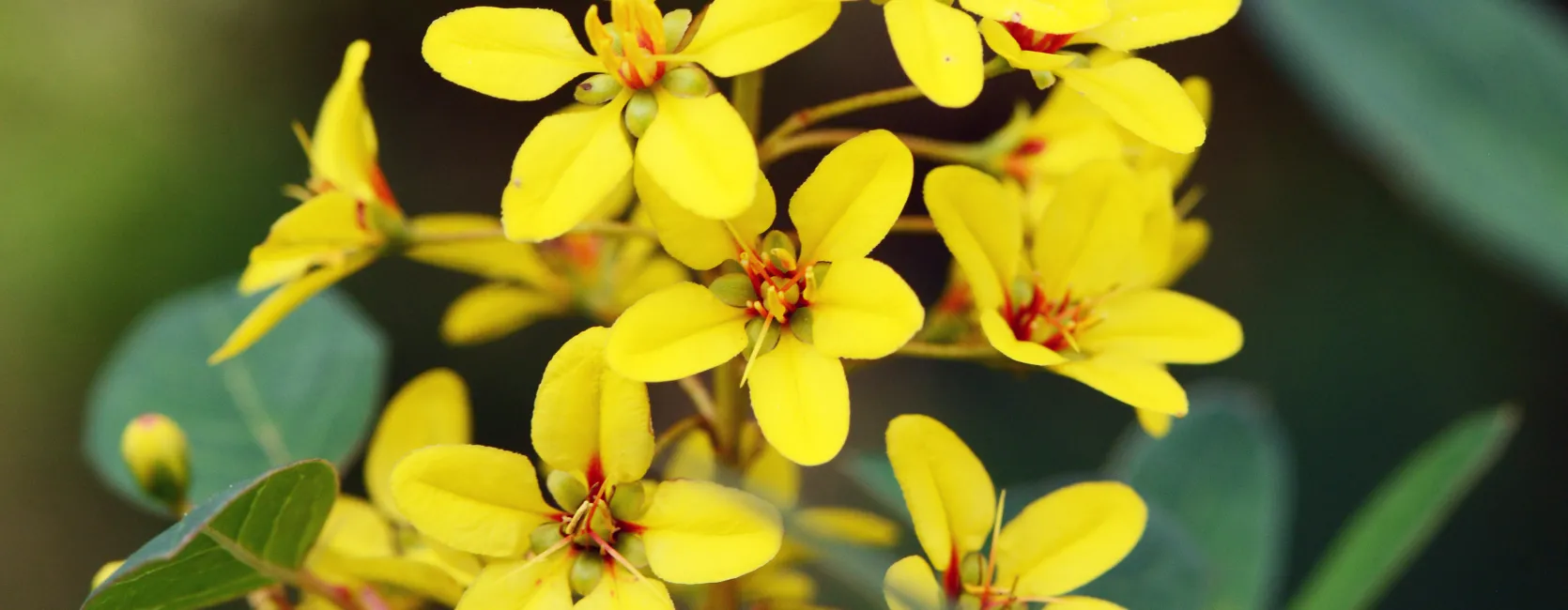
Dorr also joins colleagues in describing a new species, Ouratea chepelii (Ochnaceae), from the Andean mountains of Venezuela (Niño et al. 2023). The new species is known only from the northern slope of Guaramacal National Park and the park's buffer zone at 1800-2000m.
Ken Wurdack and colleagues describe three new species of Plukenetia (Euphorbiaceae) from Madagascar (Gillespie et al., 2024). The three species, Plukenetia analameranensis, P. antilahimenae, and P. randrianaivoi, are unusual based on morphology, pollen, and molecular data. Based on their results, the authors suggest that the three new species along with P. ankaranensis form a subclade, sister to the other two Malagasy species, P. decidua and P. madagascariensis.

In Lorence et al. (2024), Marc Appelhans and Warren Wagner join Dave Lorence (National Tropical Botanical Garden) in describing a new shrub species, Myrsine cirrhosa (Primulaceae), from the Hawaiian island of Kaua'i. This species is restricted to the remote central windward region of Kaua'i in open bogs and along open windy ridges. With less than 50 individuals and threatened by invasive, non-native animals (pigs, rats, slugs, and goats) and non-native plant competitors, the authors assess this new taxon as Critically Endangered.
While studying specimens and preparing the treatment of Mapania (Cyperaceae) for Flora of the Guianas, Mark Strong discovered material of four undescribed species (Strong et al., 2024). All four South American taxa, M. nigroventralis, M. pakaraimensis, M. waiwai, and M. wokomungensis, are endemic to tepui ecosystems in Guyana and appear to be threatened with extinction, with each receiving a preliminary conservation assessment of Critically Endangered, except M. pakaraimensis, which is assessed as Endangered. Strong also named a species, Rhynchospora hollowellii, in honor of Tom Hollowell (1954–2018), a Smithsonian staff member who managed the Biodiversity of the Guianas and National Museum of Natural History’s taxonomic databases. The species occurs in Venezuela and western Guyana.
Using molecular phylogenetics, Morgan Gostel, Carol Kelloff, Raymund Chan, the late Vick Funk, and colleagues (Gostel et al., 2024) recognize a new tribe, Distephaneae (Asteraceae), which is found in West Africa, throughout tropical and subtropical Africa and Madagascar, Mauritius, Socotra, and the Yunnan province in China. This new tribe comprises 41 species of shrubs and small trees in the genus Distephanus that are easily distinguished from sister tribes, Moquinieae and Vernonieae, based on the presence of florets with yellow corollas and trinervate leaves.
In Tu et al. (2024), Jun Wen and colleagues use molecular phylogenetics to recognize a new monotypic genus, Clavistigma, and a new tribe, Clavistigmateae, to accommodate the morphologically distinctive species Wendlandia pendula. The isolated phylogenetic position of this species was not a surprise to the authors because it is highly distinctive from all other Wendlandia species. The newly described species, Clavistigma pendula, is a shrub native to tropical and subtropical forests and thickets of Yunnan of China, Bhutan, India, Nepal, and Thailand.
The full citations of all above publications can be found listed in the Publications section of this issue of The Plant Press on page 15.